


Tokenizing securities and real-world assets on the blockchain, settling transactions in stablecoins and AI agents autonomously utilizing these financial rails – This vision of the future is already beginning to be implemented across the globe.
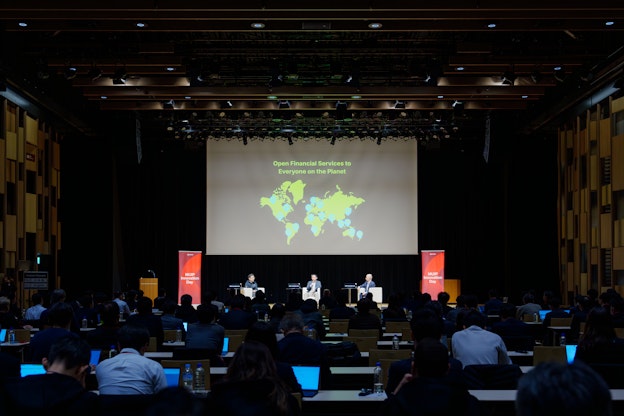
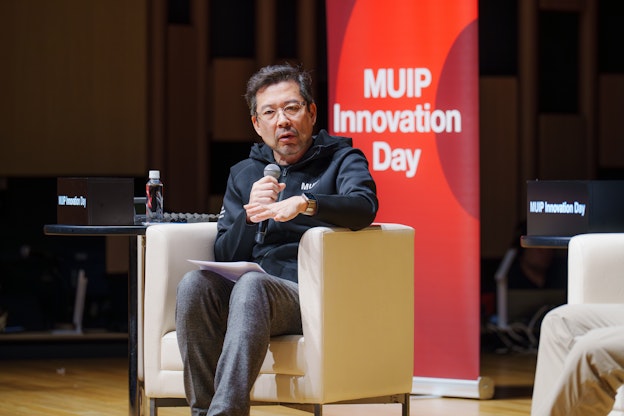
At a session during MUIP Innovation Day 2026, Hitoshi Harada, Co-founder and CPO of AlpacaDB, a U.S.-based unicorn, joined on the stage Kenta Sakakibara, Country Manager Japan at Circle, which issues the dollar-pegged stablecoin USDC. The session, moderated by Nobutake Suzuki, President and CEO of MUFG Innovation Partners (MUIP), explored the cutting edge of financial transformation at the intersection of tokenized securities, stablecoins, and AI agents.
Impact equivalent to the 1970s shift from paper certificates to private ledgers
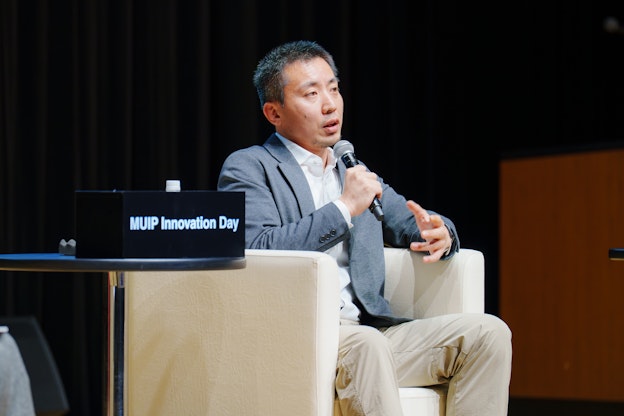
The central theme of the session was the potential impact that tokenized securities will have on global capital markets. AlpacaDB currently accounts for more than 90% of the securities custody underlying the U.S. stock tokenization market and provides infrastructure for distribution and liquidity provision.
Harada framed the historical significance of this shift as follows:
In the 1970s, the U.S. securities market moved away from physical certificate transfers to a system of recording and transferring rights on centrally managed ledgers—a transition that gave rise to what would become the DTCC. I believe the current migration to on-chain settlement carries an equivalent level of impact, and is said to be a fundamental transformation for global capital markets. (Harada)
As diverse asset classes converge on a shared settlement layer on a global blockchain, accessible in real-time to investors, there is potential to eliminate the traditional barriers that have long impeded cross-border capital flows.
The scope of tokenization extends beyond equities. According to Harada, the UAE government is actively pursuing real estate tokenization; while multiple countries, including Japan, are considering tokenization of bank deposits. In Turkey, where electronic bill infrastructure remains underdeveloped, there are moves to tokenize checks used for business payments. He also introduced a case of a treasure hunter seeking to tokenize a fund built around a collection of antiques and distribute them.
Imagine using tokenized deposits from a Turkish bank to purchase tokenized real estate in the UAE, then using that real estate token as collateral to go long on a tokenized Tesla stock while creating a long-short position in tokenized Toyota stock. A world in which the value of diverse assets across different countries can be exchanged in real time on a single shared layer—I believe that is not far off. (Harada)
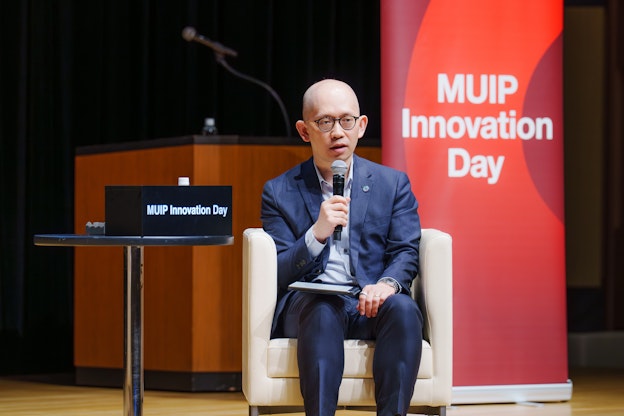
Responding to these trends, Sakakibara emphasized the opportunity for collaboration with financial institutions:
Traditional financial assets will be tokenized, and many financial services will migrate onto the blockchain. Whether banks and financial institutions embrace these new technologies will determine whether they get displaced by non-financial players. (Sakakibara)
Even globally systemically important banks (G-SIBs) – major financial institutions critical to the financial system – are rapidly expanding their use of tokenized assets.
Stablecoins as the hybrid layer – a settlement infrastructure connecting traditional finance and the on-chain economy
The role of stablecoins as the settlement backbone for tokenized asset transactions has received attention. Circle’s USDC is the world’s largest regulated stablecoin by issuance, with $77.1 billion in circulation, active in 185 countries, and supported across 32 blockchains. Founded in 2013, the company listed on the New York Stock Exchange in June 2025.
Sakakibara distilled the fundamental value of stablecoins into three properties: speed, transparency, and programmability. Key use cases include trading with cryptocurrencies and tokenized assets, as well as corporate cash management, treasury management, and cross-border remittances.
To deepen enterprise adoption, Circle is building “Arc,” its own Layer 1 blockchain. Public chains face several barriers to institutional adoption: volatility in native tokens used for gas fees, finality delays, and data privacy concerns. Arc is designed as an enterprise-grade infrastructure to resolve these issues. Participants in its testnet include Deutsche Bank and Standard Chartered, as well as Sumitomo Corporation, SBI, Coincheck, and Mercoin from Japan.
From a social impact perspective, the session highlighted Circle’s collaboration with the United Nations to channel funds to Ukraine using USDC, as well as its role in delivering financial access to unbanked populations who lack access to traditional banking.
The industry doesn’t matter for use cases. What we are trying to do is digitize money and provide a platform that makes it as easy to use as possible. (Sakakibara)
Sakakibara positioned Circle as “the operating system of the on-chain economy.”
The era when AI Agents run on financial rails – a new frontier born from fusion with blockchain
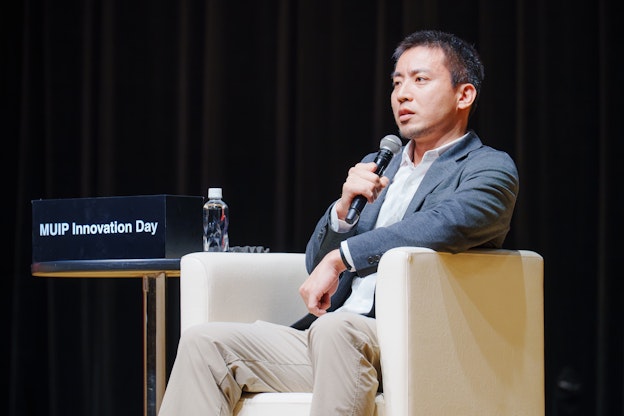
The latter part of the session featured a lively exchange on the convergence of AI with blockchain and stablecoins. Harada highlighted the growing importance of APIs in an age of AI agents:
In a world where AI agents use tools, APIs become increasingly critical building blocks. People who were not software engineers before can now work with agents to create new things. (Harada)
Alpaca obtained a U.S. broker-dealer license in 2018 and has been providing API-based securities infrastructure to clients worldwide. Established in Silicon Valley by Japanese co-founders Harada and Yoshi Yokokawa, the company raised $150 million in Series D in January 2026, growing into a unicorn with a corporate valuation of $1.15 billion. Alpaca now serves more than 300 financial institutions across 40 countries and supports over 10 million brokerage accounts. Its B2B2C end users are predominantly from emerging markets such as Turkey, Thailand, Indonesia, and Saudi Arabia—regions where access to global assets has traditionally been limited—and skew toward Millennial and Generation Z demographics.
As a concrete example, Harada described a case where the CEO of a major U.S. tech company opened a personal brokerage account with Alpaca to verify firsthand how much impact AI agents could have on market intelligence. Additionally, the emergence of ERC-8004 on Ethereum—a protocol enabling the authentication and verification of agents—signals the acceleration of movement where blockchain and AI are mutually supporting.
Harada painted an even more ambitious vision of the future, noting that AI-exclusive social networks already exist where agents communicate with one another:
When AI agents pay each other to commission work, the payment will probably be in stablecoins. (Harada)
Sakakibara echoed this perspective. Circle held a hackathon in which AI agents competed against one another, with an AI serving as judge. They also conducted an experiment where the prize money of 30,000 USDC was transferred entirely without human intervention.
Just as stablecoins function as a hybrid layer between traditional finance and tokenized assets, they may come to play a similar role between humans and AI. A world in which blockchain, AI, and stablecoins together displace existing systems may actually be closer than we think. (Sakakibara)
Assets from around the world circulate on the blockchain through tokenization; stablecoins will serve as the medium of settlement; and AI agents will leverage both autonomously. The discussion traced the concrete mechanisms by which these three technologies will replace existing financial infrastructure. Whether existing financial institutions can successfully incorporate these technologies may well determine their future competitiveness.
