



Among Southeast Asia’s fintech companies, Fazz stands out with its approach of leveraging technology to provide financial access to people in regions underserved by traditional banking services, striving to achieve financial inclusion across the region.
Based in Indonesia, Fazz Financial Group was founded in 2016 as PayFazz by Hendra Kwik, who was deeply concerned about the lack of access to banking services in Indonesia and other Southeast Asian countries. In March 2021, PayFazz and Xfers merged to create Fazz Financial Group, with PayFazz making a strategic investment of $30 million in Xfers. Both companies are Y Combinator alumni, and their shared mission of financial inclusion in Southeast Asia drove the merger. Since then, Fazz has grown into a group offering comprehensive digital financial services across Southeast Asia.
Hendra serves as Group CEO, while Xfers founder Tianwei Liu is Deputy CEO. The group now operates four businesses: “PayFazz” neobank for small medium shops in Indonesia, “BillFazz” neobank for enterprises in Indonesia, “Fazza” neobank for consumers/retails in Indonesia, and “StraitsX” for stablecoin issuance and stablecoin neobank globally beyond Indonesia. Also, by combining PayFazz’s agent network technology in rural Indonesia with StraitsX’s payment and stablecoin technology from Singapore, Fazz aims to accelerate financial access for an estimated 290 million unbanked individuals across Southeast Asia.
In the village where I grew up, major banks rarely had branches. My parents couldn’t access banking services. When I moved to a big city for university, I saw bank branches everywhere and people educated about banking products, which drove economic growth. That was something I had never seen in my hometown. (Hendra)
Fazz aims to optimize the entire spectrum of financial services—from payments and remittances to lending and savings— by providing essential services at low cost to integrate finance into the daily lives of the unbanked through digital technology.
Turning small shops (warungs) into financial access points

Hendra’s motivation to launch Fazz (originally PayFazz) came from an experience upon returning from Brazil, where he spent some time working.
When I came back from Brazil, I tried to recharge my mobile card, but it was difficult. In Indonesia, you could recharge through small shops. That reminded me of my hometown. What if we could build technology to turn small shops into access points for telecom and banking products? (Hendra)
Traditionally, Indonesians had to visit telecom for mobile data top-ups or bank branches for financial services. PayFazz connected warungs nationwide via a digital platform, enabling both mobile top-ups and remittance services. In Indonesia, warungs are quint essential, small and usually family-owned micro businesses. They can serve as both hyper local convenience store and casual dining spot.
We started with mobile data top-ups. In Japan, people can recharge at convenience stores like 7-Eleven. We built a system to let small shops offer this service. (Hendra)
Later, PayFazz added remittance and cash withdrawal features based on user feedback. However, a few months after launch, the central bank ordered operations to stop due to lack of proper licensing. This marked a turning point that pushed the company toward becoming a regulated financial institution.
We realized we needed to professionalize and institutionalize this idea. Joining Y Combinator taught us how to do that. We became one of the first Indonesian startups to be backed by Y Combinator. (Hendra)
With YC funding, the company sought to be regulatory compliant while pursuing their mission. At that time, 26-year old Hendra and the Fazz team had little to no banking experience and struggled to gain trust from the central bank.
What convinced them was the fact that we were delivering real benefits to society. People who couldn’t afford remittances before could now do so through our platform. That positive impact earned us credibility. (Hendra)
Over time, the company gained trust from the central bank by proving the value of its products to Indonesian society, and gradually expanded the set of licenses it holds. Currently, Fazz holds multiple licenses in Indonesia, including for remittances, P2P lending, banking aggregation, multi-finance, electronic money, QRIS, and payment gateway.
Education as a competitive advantage

According to Hendra, some consumer segments in Indonesia that lack access to the formal financial services sector often rely on costly informal remittance services, borrow from high-interest loan shops, and spend money on online gambling. He attributes this to a lack of education. To help resolve the problem, Fazz emphasizes education through small shops as a key differentiation point of their solution.
Many digital-first platforms exist, but even with cashback or coupons, the unbanked don’t use them. The issue isn’t the platform—it’s lack of understanding. We solve this by using small shops as financial agents to educate customers. Most apps only reach the top 20–30% of the population. We focus on the remaining 150–200 million people still relying on informal services. (Hendra)
The company’s approach goes beyond developing a neobank app; it focuses on building networks of financial service agents and banking agents. By educating unbanked customers in smaller cities and enabling them to use financial products, these apps and services become truly accessible, bringing real changes to customers’ lives. Additionally, Fazz emphasizes staying close to its users.
YC taught us to ‘make something people want.’ But you can’t do that sitting in an office. You need to go to the market—to villages, small shops, and people without banking products. If villagers can’t understand the product, we make it simple and teach them how to use it. (Hendra)
Culture, innovation, and partnership with MUFG and its affiliates
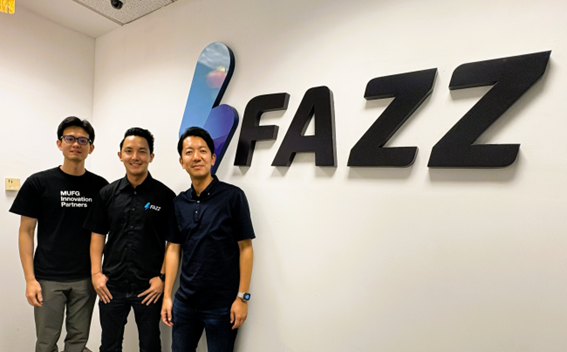
Hendra cites three cultural pillars: user-first, investing in young talent, and action-oriented execution.
Startups are fast-paced and dynamic. We constantly invest in young people. Some joined us at 24 and are now 33 after nine years here. (Hendra)
On execution speed, Hendra references YC’s philosophy:
If it takes two years to launch a product, that’s a problem. You should have answers in two days and launch within two weeks to two months. It’s not about perfect code—it’s about delivering quickly and creating impact. (Hendra)
Fazz aims to accelerate growth in Indonesia through strategic partnership with the local subsidiary of MUFG, Bank Danamon (BDI).
We’re a neobank offering banking services, but we don’t need to become a bank. Danamon (MUFG’s subsidiary), through MUIP, gives us access to products we lack via banking partners. (Hendra)
Currently, Fazz has two strategic banking shareholders: the state-owned Bank BRI and BDI. Hendra mentioned that collaboration with BDI from the private sector is said progress in a comparatively more agile fashion. Key joint initiatives include accelerating transfers and fund movements through BI Fast (Indonesia’s national, real-time payment system infrastructure) and the rollout of QRIS (Indonesia’s unified QR payment system). Although QRIS implementation took more than two months, it achieved $1 million in transactions within three months of going live.
Hendra sees MUIP as a vital bridge between startup speed and corporate scale, enabling future partnerships with other MUFG entities in Thailand, the Philippines, and Japan as Fazz expands into stablecoins and neobanking.
Speed and being a first mover are critical in tech and startups. We need bank partners because we don’t own a bank. MUIP opens those networks, which is vital for our strategy. I hope we can move from two years—or even two months—to two weeks. (Hendra)
Fazz’s bold pursuit of technology and innovation is steadily advancing financial inclusion in Southeast Asia. The company aims to continue providing greater financial access and opportunities to the unbanked by deepening financial education through small shops and leveraging digital technology, including through stablecoins in the future, to effect real world impact.
