


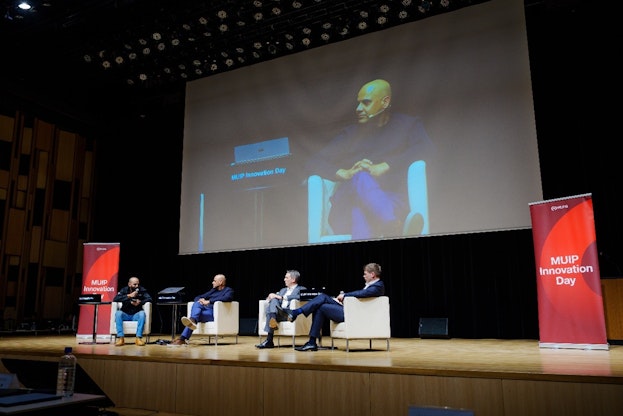
At MUIP Innovation Day 2026, Abhijat Thakur, co-founder of U.S. startup Relcu, took the stage to deliver a live demo of his company’s Agentic platform during a session titled “Finance × Generative AI: Latest U.S. Use Cases and Perspectives from a Specialist VC.”
He presented both the vision and concrete implementation (on stage demo) of transforming financial institutions’ fragmented system of record— comprising CRM systems, market automation, pipeline management., communication channels, underwriting systems, and more — into an AI powered CRM and system of action, driving customer conversion, retention and cross- sell growth.
From system of record to system of action — converting fragmented data into action driving conversion, retention and cross-sell growth
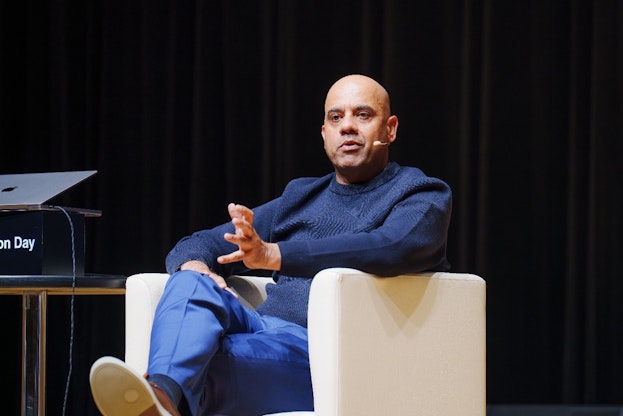
Financial institutions have long built numerous systems including CRM systems, pricing engines, loan origination systems, communication platforms,pipeline management and so on. While these systems excel at data accumulation, they lack the ability to act autonomously on those data.
Abhijat framed this challenge as “disconnected tools, siloed customer data, resulting in missed conversion opportunities, weak customer retention, operational inefficiencies and stagnant revenue growth.” The root cause lies in “very limited visibility across the customer lifecycle.”
Relcu’s approach is not to replace existing core systems, but to function as an AI execution layer on top of them that drives conversion, retention and cross-sell.
Specifically, it consists of three layers.
First is a “unified data layer” that integrates customer personal data, transaction data, and third-party data. Beyond just organizing data, Relcu activitates it in real time. Second is an “AI intelligence layer” that conducts propensity scoring and determines the next best action. AI agents are embedded directly into workflow - including lead routing, pricing, follow-ups, retention – and can plan, decide and execute actions autonomously. Third is an “execution layer” that actually engages customers via omnichannel communication and AI agents. While traditional CRMs show what has happened, Relcu decides what should happen next and executes it.
We understand your core systems are very important to you, so rather than replacing systems, we set an execution layer on top. (Abhijat)
Integration partners include Salesforce, Databricks, and Snowflake, with flexible data ingestion methods – flat-file uploads, data-warehouse integrations, and API connections – tailored to each financial institution’s governance model.
Sales automation through Voice and SMS AI agents
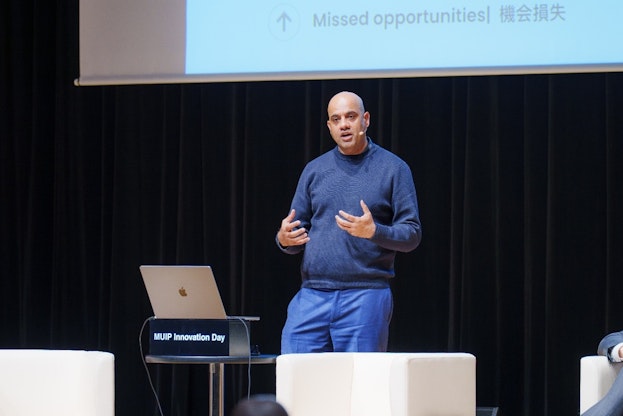
The session’s highlight was Abhijat’s live demo of mortgage sales operations. Abhijat logged into the system as a loan officer, while Mayank Shiromani, Deputy Chief Investment Officer at MUFG Innovation Partners, played the role of the customer.
The demo began with a call placed by a human loan officer.
Abhijat, in the loan officer role, called Mayank and proposed a 6.5% option against the current 7% mortgage rate. When Mayank replied that he would consider it if rates dropped below 6%, the loan officer registered him for “rate watch.”
As the call ended, a real-time conversation transcription was generated and an AI summary was automatically created. This entire set of data was integrated into a single screen within the Relcu platform.
In the next scenario, the Federal Reserve had just cut rates, bringing interest rates below the customer’s desired level. The system automatically activated an SMS AI agent and sent a text message to Mayank’s smartphone.
When Mayank replied, “I’m interested. Should I refinance?” the AI agent responded in real time. The demo even included a moment where Mayank sent an off-topic message asking, “Do you know about Pokemon?”
The AI agent provided a general explanation of Pokémon while skillfully redirecting the conversation back to the mortgage topic. Abhijat explained that this demonstrated the control rules and guardrails configured in the AI agent functioning properly.
Voice AI agents and NBA (Next Best Action) — the path to fully autonomous sales
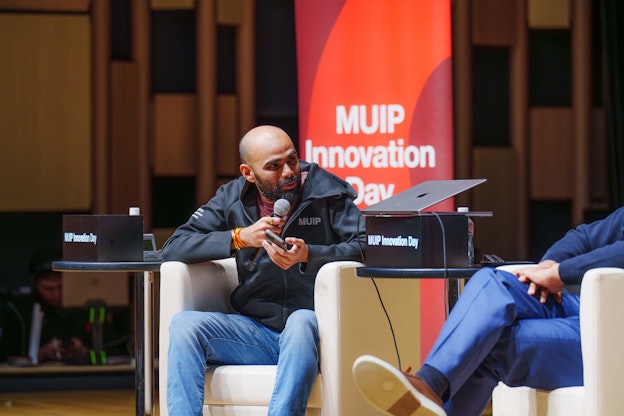
When Mayank finally requested to “connect me to a loan officer,” the AI agent created a lead in the task queue, which appeared on the loan officer’s terminal.
When the loan officer picked up the lead, a call was automatically initiated with all context, including the conversation history with the AI agent, carried forward. Additionally, the demo showed a mechanism where if the customer had not yet secured a loan, a voice AI agent would automatically place a call. The AI agent called the customer at the appropriate timing, provided rate information, and attempted to transfer the call to a human loan officer.
Our ultimate goal is to run all of this completely autonomously, with the AI agent surfacing only the optimal moments for when a human takes over and speak with the customer. (Abhijat)
The feature that drew particular attention in the demo was "Next Best Action." It integrates summaries of all customer communications (voice and SMS) with transaction and appended third party customer data, and an AI model predicts the best next action to take.
According to Abhijat, customer feedback on this recently released feature indicated that the prediction accuracy is on part with the judgement of experienced sales operator.
Implementation reality — operational in 28 Days, results proven through three ROI metrics

Relcu is currently deployed at Cardinal Financial, a top 10 mortgage lender in the U.S. The company handles $10–$15 billion in annual mortgage volume and was using ten different systems across three divisions—consumer, retail, and wholesale. Relcu has a track record of getting the system operational in 28 days for the first CD division.
This speed generates momentum and trust, which leads to confidence that the system actually works. (Abhijat)
Regarding workforce transformation on the ground, Abhijat outlined three ROI metrics Relcu focuses on in discussions with financial institutions. First is revenue growth, specifically improving lock rates (rate confirmation rates). Second is operational efficiency—optimizing personnel through improved leads and loan volume per loan officer. Third is speed—reducing time from implementation to operation.
Ultimately, we must build a product that truly helps. Not AI for AI’s sake, but driving business outcomes by solving real problems that people on the ground face. (Abhijat)
Abhijat said that if technology is trusted to achieve their goals, adoption by financial institutions accelerates. He expressed the view that visualization of results is the greatest driving force, and that when outcomes are visible, both frontline teams and organizations become positive about transformation—a view with which moderator Mayank agreed.
